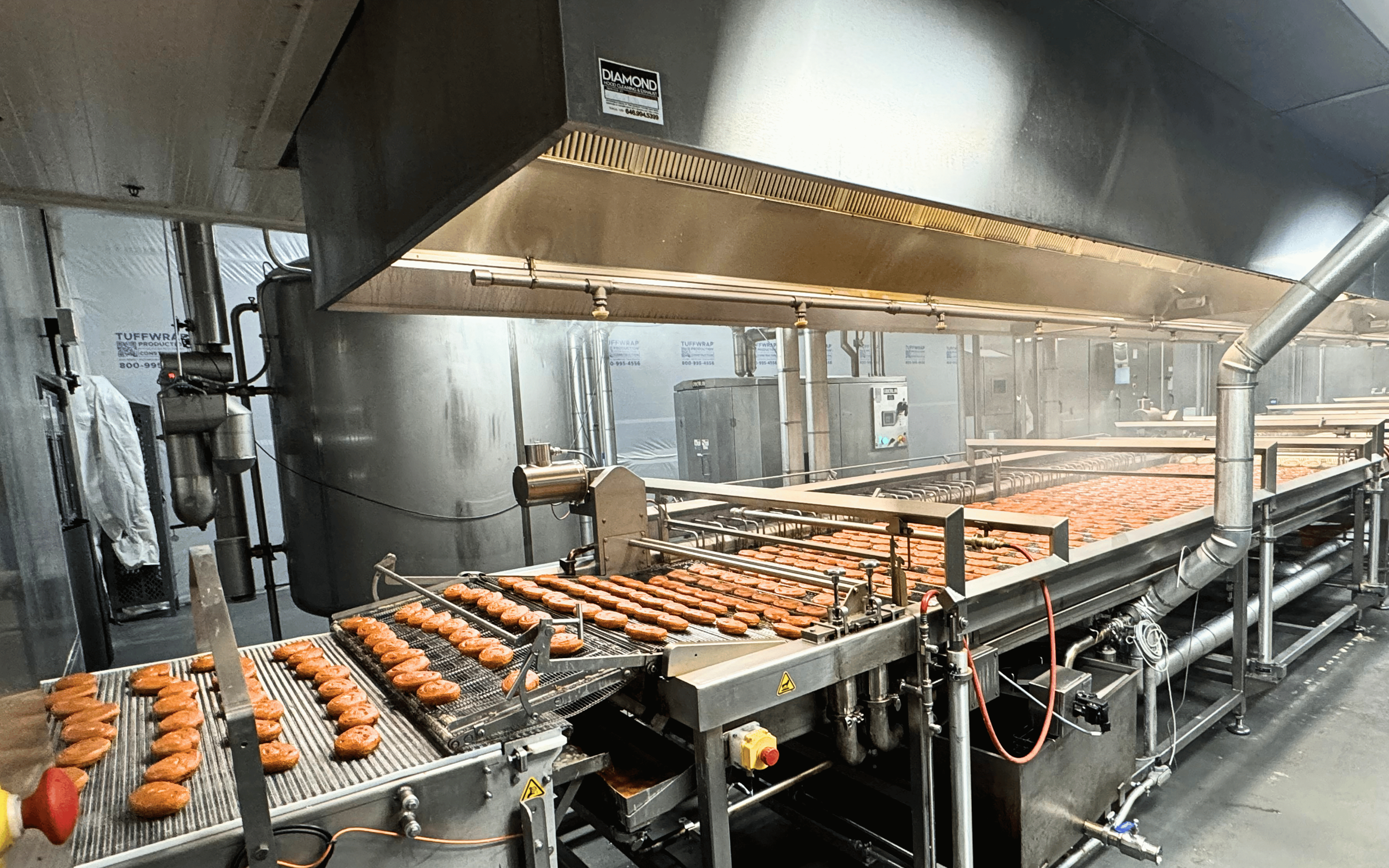
Food and beverage line relocations are among the most complex mechanical projects in industrial construction, and the stakes have never been higher. The global food and beverage market is projected to reach $9.79 trillion in 2026, growing to $11.78 trillion by 2031. That growth is driving facility expansions, capacity upgrades, and operational restructuring across the industry, and with it, more production line relocations that need to go right.
Unlike standard industrial moves, food and beverage line relocations involve equipment that must meet FDA, USDA, and HACCP compliance requirements before, during, and after reinstallation. Fillers, pasteurizers, conveyors, and packaging systems do not get a compliance pass because they are in transit. According to ABB research, unplanned downtime in the food and beverage sector can cost between $4,000 and $30,000 per hour, with a single incident capable of wiping out up to 12 hours of production. When perishable inventory is involved, the losses compound fast.
The tight integration of modern production lines further compounds the stakes. These are not independent machines that can be moved in isolation. They are sequenced systems where every component depends on what comes before and after it. That interdependency is what makes food and beverage line relocations a discipline that requires more than equipment experience. It requires a coordinated process centered on protecting the output at every stage.
The question is never whether to relocate. Facility upgrades, capacity changes, and lease transitions all force the issue. The question is how to execute the relocation without losing output, creating compliance gaps, or destroying inventory.
The Hidden Risks in Food and Beverage Line Relocations
The risks in a food and beverage line relocation are different from those in a standard industrial move, and most teams underestimate them until something goes wrong.
The first risk is regulatory. Food processing equipment does not get a pass on sanitation and safety standards because it is in transit. HACCP principles (such as hazard analysis, critical control point identification, and verification procedures) still apply after reassembly. Misaligned, improperly reconnected, or unsanitized equipment can trigger compliance failures that cost more than the relocation itself.
The second risk is sequence. Food and beverage production lines are integrated systems, not independent machines sitting side by side. Moving one piece out of order disrupts everything upstream and downstream. A conveyor reinstalled with even a minor alignment error affects fill accuracy. A filler set slightly out of position throws off labeling and packaging integrity across the entire run. These problems may lead to potential production stoppages.
The third risk is inventory. Unlike metals or electronics, food production involves raw materials and partially processed products that spoil. An extended unplanned shutdown does not just idle workers. It can destroy tens of thousands of dollars’ worth of perishable inventory within hours. Most of that loss is preventable. The risk stems from how the relocation gets executed.
How Phased Planning Keeps Production Running
The most effective food and beverage line relocations follow a phased approach built around one principle: sequence the work to protect output at every stage.
A professional relocation team first maps the full line, identifies which equipment can be moved without disrupting active production, and sequences the work accordingly. Equipment with the longest reinstallation and commissioning time moves first, giving it maximum time to come back online before the rest of the line catches up. The result is a rolling transition rather than a full shutdown.
What makes this work in practice is parallel staging. Before anything is disconnected, utilities at the destination (such as electrical, water, drainage, and compressed air) are established in advance. That eliminates the waiting period after equipment arrives and removes one of the most common sources of delay on line relocations.
Documentation before disassembly is equally critical. Every machine's connections, calibration settings, OEM specifications, and utility requirements must be recorded before a single bolt comes loose. That documentation supports the compliance reverification that FDA and HACCP require after reinstallation. Moreover, it protects the project if questions arise during inspection.
Nothing goes live at the new location until it passes commissioning. Dry runs, alignment checks, sanitation verification, and output confirmation all happen before the line cuts over. The line has to meet the same standard it met before the move.
Food and Beverage Line Relocation as a Risk Management Decision
Choosing the right partner for a food and beverage line relocation is a risk-management decision, not just a procurement decision. The contractors who execute these projects need millwright expertise, precision alignment capability, sanitary installation experience, and project management discipline…all under a single coordinated plan.
When those capabilities are fragmented across multiple subcontractors, the coordination gaps become the project's biggest liability. Sequence errors, missed utility connections, and undocumented calibration settings all become more likely when no single team owns the full scope. In a production environment where downtime can cost $30,000 per hour, and compliance failures can halt a line entirely, that fragmentation is a risk that most producers cannot afford.
A single-source mechanical contractor eliminates those gaps. One team plans the sequence, executes the move, verifies alignment and sanitation, and owns the commissioning process from start to finish. That accountability structure is what separates a line relocation that keeps production running from one that triggers the exact downtime it was meant to avoid.
The food and beverage industry is growing. Facilities are expanding. Lines are moving. The producers who execute those transitions without losing output, triggering compliance failures, or destroying perishable inventory will do so because they chose the right execution partner before the first bolt came loose.
HEMI Systems brings millwright, rigging, precision alignment, and project management capabilities to food and beverage line relocations across the United States. To discuss the scope and timeline of your next relocation, contact the team at HEMI Systems.